

: +8618979570760 :xuran1603@gmail.com WhatsApp:+8619170756831
English

Views: 0 Author: Site Editor Publish Time: 2026-08-11 Origin: Site


Choosing the wrong piping connection introduces severe operational risks. Fluid leaks, sudden maintenance downtime, and safety non-compliance can quickly derail production schedules. We must move beyond basic definitions when designing industrial systems. Deciding to use a pipe flange is a strategic calculation. You are balancing upfront installation costs against long-term maintenance needs and system flexibility. Threaded or welded joints might seem easier initially. However, they often complicate future repairs and system expansions. This guide provides an evidence-based framework to evaluate your piping connection strategy. You will learn exactly when a flanged joint becomes the optimal technical and commercial choice. We will explore critical deployment scenarios and evaluate competing connection methods. Finally, we highlight implementation realities to protect your infrastructure.
Primary function: Flange fittings are essential when systems require frequent disassembly, routine maintenance, or routine modifications.
Scenario trigger: Specify a pipe flange over threaded connections in high-pressure, large-diameter, or high-vibration environments (e.g., pump systems).
Cost vs. ROI: While flanges have a higher initial material footprint than welded joints, they drastically reduce long-term operational expenditure (OpEx) by minimizing downtime during component replacement.
Evaluation criteria: Final selection must account for a three-dimensional matrix: operational environment (pressure/temperature), material compatibility (e.g., steel vs. PVC), and maintenance accessibility.
Industrial piping relies heavily on reliable joints. Operators need systems they can manage efficiently over decades. Flanged connections offer unique advantages over permanent welds or fragile threads. They serve as the backbone of modern modular piping systems.
Imagine a high-capacity process pump failing unexpectedly. If the system uses welded joints, repair teams face a major hurdle. They must cut the pipe, physically remove the pump, and weld a new unit into place. This process demands hot work permits. It also requires extensive safety checks and prolonged system shutdowns. Flanged joints completely eliminate this destructive process. They allow for rapid component isolation. Technicians simply unbolt the connection, remove the faulty valve or compressor, and drop a replacement directly into the line. This accessibility slashes repair timelines. It turns days of costly downtime into mere hours of routine maintenance.
Modern industrial plants rarely remain static. Production lines evolve, capacities increase, and layouts shift. Flanged systems support modular plant expansion beautifully. You can add spool pieces or reroute lines seamlessly. This becomes a predictable, quantifiable process rather than a custom fabrication nightmare. Plant managers can pre-fabricate flanged pipe sections off-site. They bring them into the facility and bolt them together quickly. This modularity reduces on-site labor drastically. It also minimizes operational disruptions during facility upgrades.
Flanged connections deliver immense mechanical advantages. They distribute load evenly across a bolted face. This design handles mechanical bending forces exceptionally well. However, we must be transparent about implementation realities. While inherently strong, a flanged joint relies heavily on proper execution. Its structural integrity depends directly on optimal gasket selection and strict bolt-torquing procedures. A flange is only as reliable as the installation method used.
Best Practice: Always use calibrated torque wrenches during installation to ensure even load distribution across the flange face.
Common Mistake: Reusing old gaskets after opening a flanged joint. This practice severely compromises seal integrity and leads to inevitable leaks.
Not every pipe connection requires a bolted flange. Engineers must identify specific scenarios where flanges outperform alternative methods. Specifying the right joint depends on physical constraints, safety requirements, and equipment types.
Pipe size plays a massive role in connection strategy. We generally establish a clear threshold for flange utilization. For pipes larger than four inches in diameter, threading becomes mechanically impractical. The machinery required to thread massive steel pipes is enormous and unwieldy. Meanwhile, welding large-bore pipes creates permanent fixtures. These permanent welds become cost-prohibitive for future maintenance. Flanges bridge this gap perfectly. They provide a robust, demountable connection for large-diameter infrastructure.
Pumps, compressors, and control valves are dynamic pieces of equipment. They vibrate heavily and require frequent servicing. You must connect them using flanges. A flanged connection allows for vital vibration dampening. Engineers achieve this by specifying specific elastomeric or spiral-wound gaskets between the mating faces. Furthermore, flanges enable rapid equipment swap-outs. When a pump seal fails, technicians can detach the unit immediately without touching the main piping header.
Safety remains paramount in petrochemical and power generation facilities. Volatile fluids demand absolute sealing certainty. Organizations like ASME and ANSI strictly regulate these environments. Flanges offer verifiable, testable seals for these volatile fluids. Threaded connections often suffer from micro-leaks under high pressure. These leaks are unacceptable when transporting toxic or highly flammable materials. Specifying correctly rated flanges ensures full compliance with global safety standards.
Material properties dictate connection choices. Consider rigid plastic materials like PVC or CPVC. Installers frequently overtighten threaded plastic joints to prevent leaks. This overtightening introduces massive internal stress. The plastic eventually succumbs to stress-cracking and catastrophic failure. Flanges prevent this issue entirely. A bolted face distributes compressive force evenly across the plastic material. This approach protects brittle pipes from localized thread stress.
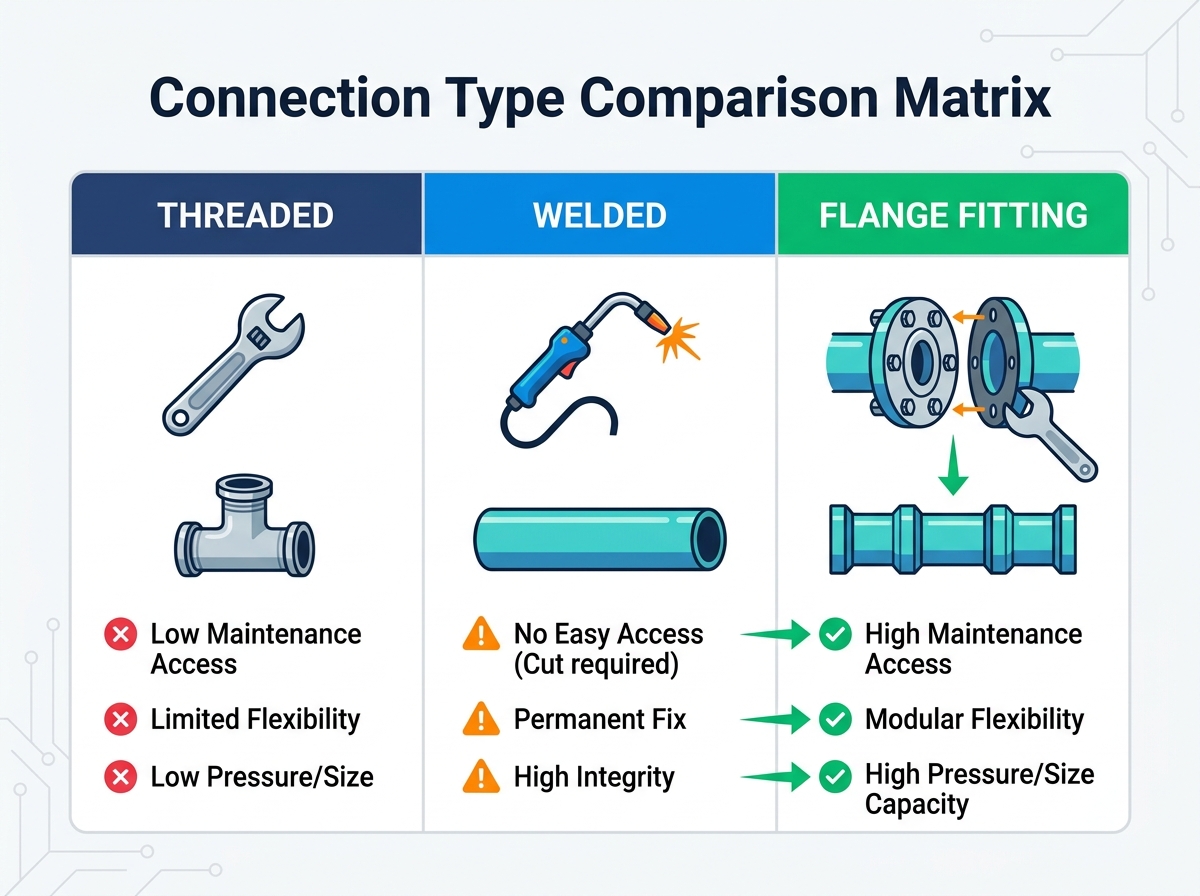
Choosing a connection method requires a balanced comparison. We use a three-dimensional evaluation matrix to map these options. This framework helps engineers weigh maintenance needs against structural permanence.
Connection Method Evaluation Matrix
Connection Type | Best Uses & Ideal Applications | Maintenance Burden | System Flexibility |
|---|---|---|---|
Flanged | Main process lines, dynamic equipment, large diameters. | Moderate. Requires routine torque checks and gasket replacements. | High. Modular design allows for rapid disassembly and rerouting. |
Welded | High-pressure permanent utility lines, inaccessible pipelines. | Low to Zero. A perfect weld requires no ongoing physical maintenance. | Low. Modifications require destructive cutting and hot work permits. |
Threaded | Small-bore utility lines, low-pressure non-hazardous fluids. | High over time. Very susceptible to vibration loosening and leaks. | Moderate. Can be disassembled but often cross-threads or seizes. |
You must provide a balanced view of infrastructure costs. Using a flange constitutes "over-engineering" for low-pressure, permanent, small-bore utility lines. Threaded or welded joints handle simple water lines perfectly well. However, flanges remain the only logical choice for main process lines requiring inspection. The initial cost of flanges, bolts, and gaskets exceeds the cost of a simple weld. Yet, the long-term operational savings justify this expense. Minimizing just one hour of factory downtime often pays for the entire flanged assembly.
Theoretical benefits mean little without proper field execution. Engineering teams must acknowledge the practical risks of bolted connections. Understanding these realities prevents expensive field failures.
A flanged joint is not a single solid object. It operates as a dynamic system of three distinct components. You have the flanges themselves, the sealing gasket, and the threaded bolting. A failure in any one component compromises the whole assembly. If you use cheap bolts that yield under pressure, the joint leaks. If you select a gasket incompatible with the process fluid, the seal degrades. You must engineer the entire triad cohesively.
Field installation introduces significant human error risks. Uneven bolt tightening represents the most common mistake. Mechanics sometimes rush and tighten one side completely before moving to the other. This uneven pressure crushes the gasket on one side and causes immediate blowouts. Another major risk involves forced alignment. Installers sometimes force mismatched pipe runs together using the flange bolts. This practice introduces massive baseline stress into the piping system. The equipment will eventually fracture under this unnatural tension.
Align the pipe faces perfectly before inserting any bolts.
Insert all bolts and hand-tighten them evenly.
Use a calibrated tool to apply torque in a strict crisscross or "star" pattern.
Conduct a final rotational check at the specified torque value.
We must transparently note physical limitations. Flanged connections require significantly more physical clearance than welded joints. Technicians need room to swing large wrenches and operate hydraulic torque tools. If you design piping too close to a wall, maintenance becomes impossible. Additionally, solid steel flanges add significant dead weight to the piping infrastructure. You must compensate for this mass. The system will require highly robust pipe supports and engineered hangers to prevent sagging.
Transitioning from theory to procurement requires a structured approach. Buyers and engineers need clear steps to finalize their exact connection requirements.
Advise your team to document their strict non-negotiables upfront. Vague requirements lead to purchasing errors. Write down specific operational goals. Examples might include "Must pass API 6D standards" or "Must allow annual pump removal in under two hours." These defined criteria eliminate unsuitable options immediately. They keep procurement focused on long-term reliability rather than just the lowest initial purchase price.
You must ensure absolute compatibility across your system. Check the selected flange face carefully. Common variations include Raised Face (RF), Flat Face (FF), and Ring-Type Joint (RTJ). You cannot mix these face types safely. Additionally, verify the pressure class. A Class 150 component handles vastly different pressure thresholds than a Class 600 component. Ensure your selected rating aligns perfectly with the system’s maximum pressure and temperature threshold.
Your connection strategy relies entirely on product quality. We strongly recommend shortlisting suppliers who maintain rigorous documentation. Demand full material traceability. Vendors should provide Material Test Reports (MTRs) for every component. They must also document strict compliance with ANSI/ASME standard frameworks. Avoid unknown suppliers who cannot verify their metallurgical sources. A single substandard casting can cause catastrophic facility damage.
The decision to utilize a flange ultimately hinges on future accessibility. Operators facing extreme operational conditions and routine maintenance schedules require demountable connections. While upfront costs appear higher than simple welding, the operational savings become undeniable. You avoid destructive cutting, bypass hot work permits, and slash maintenance downtime.
Your next step involves a thorough facility audit. Review your current maintenance pain points. Identify areas where equipment removal takes too long or where threaded joints frequently leak. Document these specific bottlenecks. We encourage buyers to consult directly with technical specialists. An expert can match exact flange specifications to your specific Piping and Instrumentation Diagram (P&ID) requirements. Do not leave your critical infrastructure to guesswork. Reach out to our technical sales team today to discuss your next major piping project.
A: Yes, they carry a higher upfront component cost due to the required flanges, bolts, and gaskets. However, they drastically lower your labor and downtime costs during maintenance. The ability to unbolt a joint rather than cut and re-weld pipe offers massive long-term operational savings.
A: No. Mixing different face types introduces severe technical risks. For example, bolting a Raised Face (RF) flange to a Flat Face (FF) flange creates uneven stress. This mismatch often cracks the flat-faced component, especially if it is cast iron or plastic. Industry standards strongly prohibit this practice.
A: Replacement frequency depends heavily on thermal cycling and fluid corrosivity within your system. However, one rule remains absolute: you must always replace the gasket whenever a flanged joint is opened. A compressed gasket permanently loses its elastic recovery and will not seal properly a second time.