

: +8618979570760 :xuran1603@gmail.com WhatsApp:+8619170756831
English

Views: 0 Author: Site Editor Publish Time: 2026-07-20 Origin: Site


Pressurized piping systems demand absolute structural integrity to operate safely. The ASME B16.5 standard serves as the universal backbone for achieving this reliability across global industrial facilities. However, many engineering teams misinterpret critical pressure-temperature (PT) ratings when specifying a pipe flange. Treating a nominal class rating as a static pressure limit introduces massive operational and financial risks. Such errors frequently lead to catastrophic fluid leaks, failed safety audits, or severe over-specification. These mistakes needlessly bloat project budgets and delay construction timelines.
You must understand how these ratings actually function dynamically in the field. This guide provides a practical, engineering-first framework for evaluating and sourcing ASME B16.5 compliant components. We will explore how material selection influences ratings and how to avoid common procurement pitfalls. By the end, you will know exactly how to specify the right part for your specific process conditions.
ASME B16.5 pressure classes (150–2500) are not static psi limits; they are dynamic ratings that decrease as operating temperatures increase.
Material composition directly dictates the pressure-temperature ceiling of any given pipe flange.
Strict adherence to B16.5 dimensions and tolerances is non-negotiable for system standardization, reducing long-term inventory and maintenance costs.
Validating supplier compliance requires rigorous auditing of Material Test Reports (MTRs) and strict traceability protocols.
Industrial facilities run on precision and predictability. Deviating from established engineering codes introduces unacceptable variables into your process lines. By adhering strictly to the ASME B16.5 standard, you protect both your personnel and your project budgets.
Standardizing your components on ASME B16.5 parameters significantly reduces procurement bottlenecks. When you specify standard dimensions, multiple vendors can easily supply the required parts. This competitive environment drives down unit costs and shortens lead times. Custom-engineered joints often require specialized machining and unique gaskets. They complicate future repairs and inflate lifecycle maintenance costs. Standardized systems allow maintenance crews to swap parts seamlessly during emergency outages. This interchangeability keeps plant downtime to an absolute minimum.
You face serious legal, safety, and compliance implications if you deviate from recognized PT tables. Industrial environments like petrochemical plants and power generation facilities operate under immense regulatory scrutiny. Inspectors actively look for undocumented or non-compliant piping joints. A failed pressure boundary can release lethal chemicals or explosive gases into the workspace. Strict adherence to ASME guidelines proves you exercised proper engineering diligence. It shields your organization from liability and prevents catastrophic environmental incidents.
Engineering teams frequently fall into the over-engineering trap. They specify Class 600 components when Class 300 parts would safely handle the process conditions. This happens when designers fail to understand precise standard limits. Heavier class ratings require more raw material, longer welding times, and more expensive fasteners. Understanding exact pressure-temperature curves allows you to select the precise flange class required. You optimize the design and prevent your team from overspending on unnecessary pressure margins.
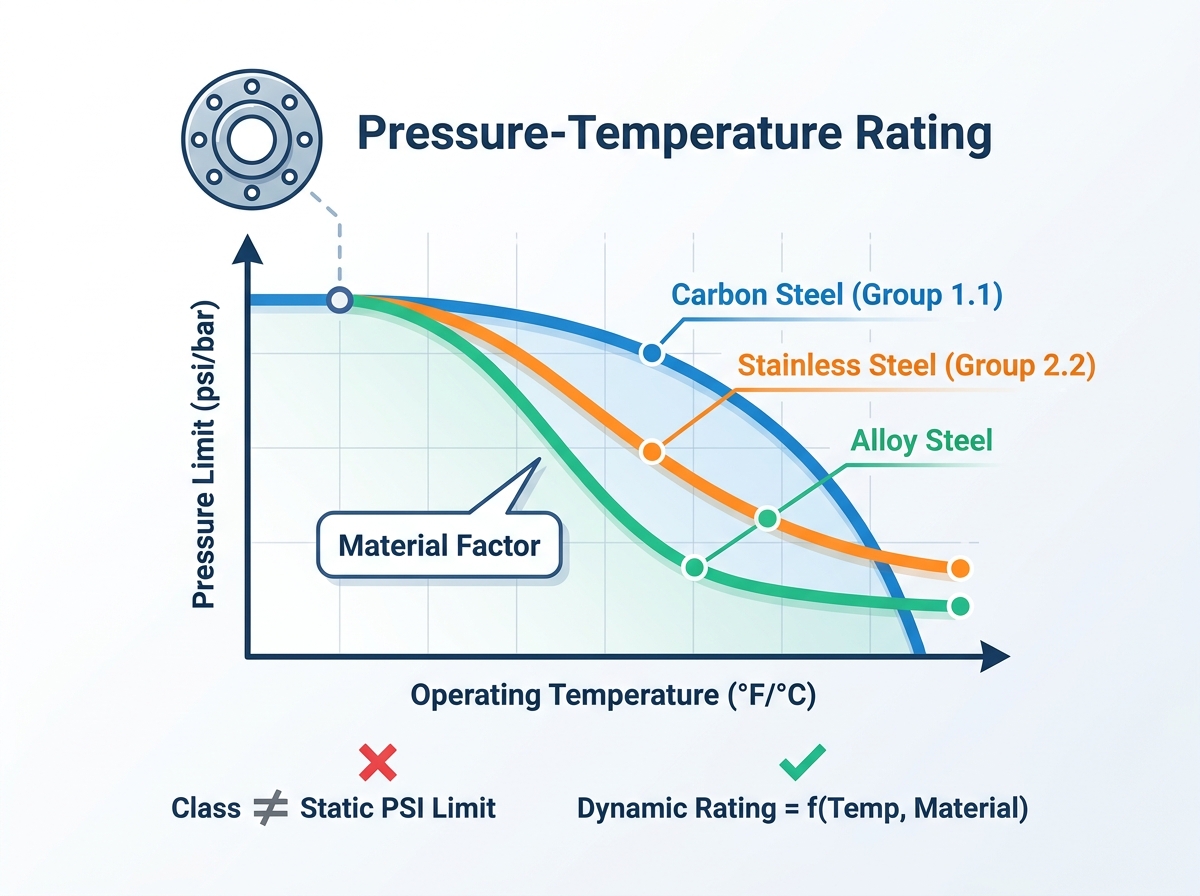
Engineers must break the habit of viewing pressure classes as static numbers. A component's physical ability to contain pressure changes dramatically as thermal energy enters the system.
A Class 150 designation does not equate to a 150 psi working limit. The ASME standard uses a pressure-temperature rating matrix to define safe operating boundaries. Ratings fluctuate inversely regarding temperature. As system heat rises, the metallic grain structure loses yield strength. To compensate for this metallurgical weakening, the code mandates a corresponding drop in allowable internal pressure. You must cross-reference your exact operating temperature against your specific material group to find the true pressure ceiling.
Example Pressure-Temperature Derating (Carbon Steel Group 1.1)
Temperature (°F) | Class 150 (psig) | Class 300 (psig) | Class 600 (psig) |
|---|---|---|---|
-20 to 100 | 285 | 740 | 1480 |
200 | 260 | 680 | 1360 |
400 | 200 | 635 | 1270 |
600 | 140 | 570 | 1140 |
Selecting the correct pressure class requires a careful analysis of your process severity. You must evaluate both normal operating states and potential upset conditions.
Baseline utility lines usually operate at predictable pressures and ambient temperatures. Cooling water, compressed air, and low-pressure steam systems typically fall into this category. You should specify Class 150 or Class 300 components for these applications. These lower classes provide adequate safety margins without burdening the installation crew. They weigh less, require smaller bolts, and simplify the overall assembly process.
High-pressure/high-temperature (HPHT) applications demand serious scrutiny. Deepwater hydrocarbon extraction, chemical cracking processes, and superheated steam generation operate in extreme environments. For these systems, you must evaluate Class 600, 900, 1500, and 2500 options. Your decision criteria must focus heavily on peak upset temperatures. A system running normally at 800 psi might seem fine for Class 300. However, if the process temperature routinely spikes to 800°F, you must upgrade the class to maintain structural integrity.
Steady-state calculations rarely tell the whole story. You must factor system transients into your final specifications. Thermal expansion creates immense mechanical stress on bolted joints during startup and shutdown cycles. Dynamic loads from vibrating pumps can accelerate fatigue failures. System surges, like water hammer events, create instantaneous pressure spikes. These spikes easily exceed standard operating pressures. You should select a class rating robust enough to absorb these temporary hydraulic shocks safely.
Geometry alone does not dictate strength. The base metallurgy you select determines how well your piping components survive corrosive fluids and intense heat.
The standard categorizes approved materials into distinct numerical groups. Each group shares similar metallurgical properties and allowable stress values. For example, Group 1.1 covers common carbon steel grades like ASTM A105. Group 2.2 covers austenitic stainless steels like ASTM A182 F316. The code assigns specific pressure-temperature tables to each material group. You cannot use a Group 1.1 table to evaluate a Group 2.2 component. Doing so will yield highly inaccurate and dangerous pressure limits.
Choosing the right base material requires you to balance corrosion resistance, temperature stability, and unit cost. Use this decision matrix to guide your selection:
Carbon Steel: Excellent for non-corrosive environments like oil, gas, and standard water lines. It offers high mechanical strength at ambient temperatures and provides the most economical unit cost. However, it oxidizes quickly and loses strength rapidly above 800°F.
Alloy Steel: Ideal for high-temperature service. Grades containing chromium and molybdenum handle superheated steam effectively. They resist metallurgical creep over long service lives. They cost more than carbon steel but perform much better under extreme thermal stress.
Stainless Steel: The best choice for highly corrosive chemical processes and cryogenic applications. Austenitic grades maintain exceptional toughness at sub-zero temperatures. They represent the highest initial material investment but prevent costly premature corrosion failures.
Modern steel mills frequently produce materials carrying dual certifications, such as 316/316L. Standard 316 stainless contains higher carbon, offering better structural strength at high temperatures. The "L" grade (316L) contains lower carbon to prevent carbide precipitation during welding. Dual-certified material meets the chemical requirements of the L-grade and the mechanical strength requirements of the standard grade. However, you must remain careful. At elevated temperatures (typically above 1000°F), the code limits allowable stresses for low-carbon grades. You must use the most conservative rating table when evaluating dual-certified parts for hot service.
Even the best engineering models fail if you ignore practical implementation details. Field execution presents numerous opportunities for dangerous specification errors.
A B16.5 flange rating is only as strong as its weakest joint component. Engineers frequently specify heavy-duty pressure classes but fail to upgrade the accompanying hardware. If you bolt a Class 1500 joint together using low-yield commercial fasteners, the connection will leak long before reaching its code limit. Similarly, the gasket material must survive the process chemistry and temperature. You must align your bolt material grades (like ASTM A193 B7) and spiral-wound gasket specifications directly with your chosen pressure class.
Industry veterans still casually refer to these components as "ANSI flanges." This historical terminology stems from when the American National Standards Institute directly published the document as ANSI B16.5. Today, the American Society of Mechanical Engineers governs the standard. While the dimensions remain functionally identical, you must clarify this transition to prevent procurement errors. Specifying outdated "ANSI" standards on modern purchase orders can trigger QA rejections. Always use current ASME B16.5 terminology to ensure your documentation remains accurate and auditable.
The code provides pressure limits at specific temperature intervals (e.g., 200°F, 300°F, 400°F). When a process operates at 345°F, designers sometimes try to guess the allowable pressure through linear interpolation. This practice introduces dangerous errors. The yield strength of metals does not degrade in a perfectly straight line. You must use strict standard-provided calculations or conservatively round up to the next highest temperature bracket. Guessing between documented points compromises the structural integrity of your entire piping system.
A perfect specification means nothing if the manufacturer delivers inferior hardware. You must rigorously audit your supply chain to guarantee field safety.
Inspectors must verify physical markings immediately upon material delivery. The ASME code strictly regulates how manufacturers stamp their products. You should look for five critical identifiers permanently forged or stamped into the outside rim. These include the manufacturer's logo, the specific ASME standard (B16.5), the pressure class, the precise material grade, and a unique heat number. If any of these markings appear illegible or missing, you must quarantine the parts immediately.
Paperwork validation requires extreme diligence. Every compliant component ships with a Material Test Report (MTR). You must cross-reference the physical heat number stamped on the metal directly with this document. The MTR proves the exact chemical composition and mechanical properties of the raw steel batch. Ensure you receive original, untempered documentation directly from the producing mill. Fraudulent MTRs represent a massive liability in the industrial sector. Train your receiving team to spot altered dates, mismatched fonts, or missing mechanical test data.
Do not select vendors based purely on unit price. You must prioritize manufacturing quality and traceability. Use the following criteria to shortlist reliable suppliers:
ISO 9001 Compliance: Ensure the manufacturer maintains a certified quality management system to prevent undocumented process variations.
Origin of Raw Materials: Verify where the supplier procures their steel billets. Restrict purchases to mills with proven metallurgical track records.
In-house NDT Capabilities: Prioritize vendors equipped to perform non-destructive testing (NDT), such as ultrasonic or magnetic particle inspections, directly on their factory floor.
You must formulate a standardized Request for Quote (RFQ) that enforces compliance without ambiguity. Do not send generic lists to your vendors. Specify the exact ASME B16.5 edition year. Dictate the required material group, facing type, and required MTR documentation level. When you eliminate ambiguity upfront, suppliers quote accurate prices. This rigor prevents substandard parts from ever reaching your facility.
Specifying an ASME B16.5 component requires a dynamic calculation of internal pressure, thermal energy, and specific material limits. You cannot treat these decisions as static catalog selections. Overlooking the complex inverse relationship between heat and allowable stress invites catastrophic failure. Always map your exact operating parameters against the correct material group matrix before making a final selection.
To ensure total project safety, your procurement and engineering teams must collaborate early. Integrate rigorous B16.5 pressure-temperature rating checks strictly into your initial P&ID (Piping and Instrumentation Diagram) reviews. Validate all supplier markings and material test reports before installing a single bolt. By following these disciplined engineering practices, you will build safe, compliant, and highly reliable piping systems.
A: They refer to the same fundamental standard, but ASME (American Society of Mechanical Engineers) is the current governing body. The ANSI designation is historically accurate but functionally obsolete for modern procurement. You should always reference ASME B16.5 on current engineering drawings and purchase orders to ensure compliance.
A: Yes, it certainly can. At ambient temperatures, a Class 150 component forged from Group 1.1 carbon steel can typically handle up to 285 psi. The "150" designation represents a nominal class, not an absolute maximum working pressure. Always consult the specific pressure-temperature matrix for your exact material grade.
A: No, it does not. The ASME B16.5 standard specifically governs sizes from NPS 1/2 through NPS 24 metric/inch equivalents. For diameters larger than 24 inches, you must direct your specifications to the ASME B16.47 standard, which covers large diameter steel flanges up to NPS 60.
A: Operating temperature and allowable pressure share an inverse relationship. As process temperatures rise, the metallic material loses yield strength. Consequently, the standard derates the maximum allowable working pressure. You must calculate your component's rating based on your system's absolute maximum design temperature, not just the normal operating baseline.