

: +8618979570760 :xuran1603@gmail.com WhatsApp:+8619170756831
English

Views: 0 Author: Site Editor Publish Time: 2026-07-24 Origin: Site


Bolting a joint might seem like a basic mechanical task. Industrial systems rely heavily on secure connections to transport volatile fluids safely. However, this process is a critical engineering procedure where failure results in fugitive emissions, catastrophic leaks, and unplanned downtime. Proper technique separates secure industrial operations from hazardous environments.
Many technicians assume applying maximum force ensures a secure seal. In reality, successful tightening requires achieving uniform clamping force across the gasket rather than simply maximizing tightness. Uneven pressure crushes gaskets and warps metal surfaces. This guide explores the proven methods for achieving a leak-free pipe flange connection. We will examine industry-standard methodologies, ASME frameworks, and essential equipment evaluation criteria. You will learn exact sequences to guarantee long-term joint integrity. By mastering these procedures, maintenance teams can eliminate rework entirely.
Improper tightening sequences account for the majority of joint leaks; uniform gasket compression is the primary success metric.
Industry-standard ASME PCC-1 guidelines mandate a multi-pass, cross-pattern sequence (typically 30%, 60%, and 100% target torque) to prevent flange distortion.
Accurate torque application requires calibrated tooling and proper stud lubrication to manage friction (the K-factor).
Evaluating and procuring bolting equipment or pre-assembled flanges requires strict attention to material traceability and manufacturer compliance.
Improper bolting procedures introduce massive operational risks. When technicians apply uneven pressure, they cause uneven gasket crush. This uneven compression creates microscopic leak paths. Volatile gases or corrosive liquids escape through these microscopic gaps. These leaks trigger severe environmental compliance violations. Regulatory bodies frequently issue heavy fines for fugitive emissions. You also risk permanent damage to the metal faces. Scratched or warped surfaces require expensive onsite machining.
We often encounter the dangerous "over-torquing" myth. Many operators mistakenly believe tighter is always better. They apply maximum force to stop minor leaks. This approach destroys the structural integrity of the fastener. Bolts function exactly like heavy-duty springs. When you tighten them, they stretch to generate clamping force. If you apply excessive torque, you stretch the bolt beyond its yield point. It undergoes plastic deformation and permanently loses its elasticity. The gasket also suffers. Over-torquing crushes the sealing material until it shatters or extrudes out of the joint.
You must define success correctly. A successful installation guarantees long-term joint integrity. We measure this success by zero-leak operations across thousands of thermal cycles. Furthermore, you must maintain verifiable maintenance logs. These logs prove your facility follows strict engineering standards. They protect your business during safety audits and insurance inspections.
Preparation dictates the success of your installation. You cannot achieve a secure seal with defective components. Thorough component inspection is a mandatory first step. You must verify the physical condition of every part before assembly begins.
Serrated Faces: Inspect the metal faces for radial scratches. A scratch crossing the serrations provides a direct leak path. Reject components with deep gouges.
Gaskets: Ensure the gasket is entirely new. Look for bends, creases, or unraveled spiral windings.
Fasteners: Check studs and nuts for corrosion, burrs, or damaged threads. A nut must thread down the entire stud easily by hand.
Next, you must select the appropriate tooling. Your choice depends heavily on the application size and pressure class. We typically choose calibrated manual or pneumatic torque wrenches for standard maintenance. These wrenches are highly effective for most standard industrial systems. However, high-pressure and large-diameter applications require different tools. For these critical joints, you should use hydraulic tensioners. Tensioners pull the stud directly to stretch it. They eliminate rotational friction entirely. This provides incredibly precise bolt load.
Lubrication plays a pivotal role in manual and torque-wrench tightening. We cannot overstate its importance. Torque is simply a measurement of rotational resistance. When you turn a dry nut, friction consumes up to 50% of your applied torque. Only a fraction of your effort actually stretches the bolt. You must apply an appropriate anti-seize compound to the stud threads and the nut bearing surfaces. The lubricant manages the friction coefficient, known as the K-factor. Proper lubrication ensures your torque readings translate into actual, measurable bolt stretch.
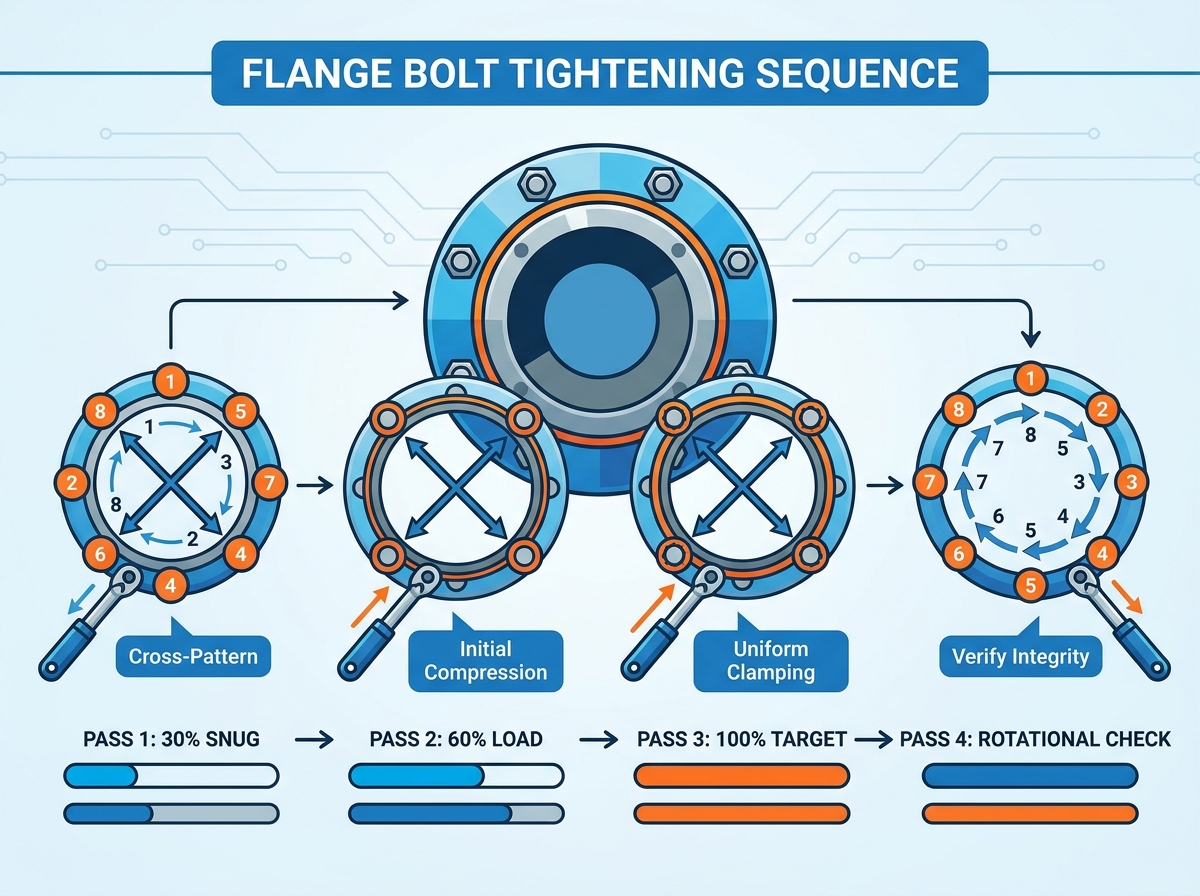
You can never tighten bolts in a simple circular motion. This approach pinches the gasket on one side. It forces the metal faces out of parallel alignment. Once the faces tilt, a leak is practically guaranteed. You must use a mandatory cross-pattern sequence. This star pattern ensures perfectly even load distribution.
Imagine a clock face. You tighten the bolt at 12 o'clock, then immediately move across to 6 o'clock. Next, you move to 3 o'clock, then across to 9 o'clock. You continue this crisscross method until you address every fastener. We execute this cross-pattern over four distinct passes to achieve uniform compression.
Pass 1 (The 30% Load): You apply exactly 30% of your final target torque. Use the cross-pattern sequence. This initial pass snugs the bolts. It gently seats the gasket into the serrations without crushing the material.
Pass 2 (The 60% Load): You increase your wrench setting to 60% of the target torque. Follow the exact same cross-pattern. This pass builds initial compression and begins stretching the fasteners evenly.
Pass 3 (The 100% Load): You set your equipment to 100% of the target torque. Maintain the cross-pattern. As you complete this pass, you must visually monitor the joint. Ensure the faces remain perfectly parallel.
Pass 4 (The Rotational Check): This is the final verification stage. You change your pattern. Perform a "round-robin" or circular pass at 100% torque. Move sequentially from bolt to bolt in a circle. You will often find loose studs during this pass. Tightening one side of a joint frequently relaxes the bolts on the opposite side. This circular pass catches those relaxed studs.
Industrial bolting is a highly regulated science. We ground our entire tightening procedure in established engineering frameworks. The primary standard is ASME PCC-1 (Guidelines for Pressure Boundary Bolted Flange Joint Assembly). This document serves as the absolute authority for preventing joint failure. Adhering to ASME PCC-1 provides a powerful compliance lens. It protects your facility from liability.
You must understand the variables that dictate torque data. Never guess a torque value. Never use a generic number from the internet. You must read engineered torque charts properly. These charts factor in several critical variables.
Variable | Impact on Torque Requirements |
|---|---|
Pressure Class | A 150# class system requires significantly less clamping force than a 300# or 600# system. Higher pressure classes demand thicker materials and higher torque. |
Stud Material Grade | Standard B7 alloy steel bolts handle different stress levels than B8M stainless steel bolts. You must match the torque to the metal's specific yield strength. |
Gasket Type | Spiral wound metal gaskets require immense seating stress to seal. Soft elastomeric (rubber) gaskets require low torque to avoid crushing them. |
Friction Factor (K-Factor) | The specific lubricant used changes the friction coefficient. Changing the lubricant without adjusting the torque value guarantees failure. |
Documentation is a vital component of the ASME protocol. You must treat every joint assembly as an auditable event. Technicians must log specific data points. Record the final torque values applied. Document the exact tool used and its latest calibration date. Require clear operator sign-offs. These operational audits prove your compliance. They provide essential data if troubleshooting becomes necessary later.
Successful installations begin long before tools touch the metal. Your choice of supply partners heavily influences your operational risk. You need strict shortlisting logic when selecting industrial hardware vendors or mechanical contractors.
We prioritize suppliers who maintain active ISO certifications. This proves they operate under rigorous quality management systems. Furthermore, you must demand Material Test Reports (MTRs) for all fasteners and pressure-retaining components. MTRs provide exact chemical and physical property data. They guarantee the steel you purchased meets the required standards. Without traceability, you introduce dangerous unknowns into high-pressure systems.
Scalability requires risk mitigation. When executing large-scale piping projects, partner with suppliers who provide comprehensive engineering support. The best vendors supply application-specific torque charts. They offer engineered solutions rather than just raw materials. When you need to procure a reliable flange, you must select partners who understand complex bolting mechanics.
Your immediate next-step action is internal review. Consult with your onsite engineering teams. Review your specific pressure-temperature ratings. Cross-reference these ratings against your current bill of materials. You must complete this verification before finalizing procurement. It prevents expensive delays during the construction phase.
Flange tightening is an exact science. It depends entirely on proper tightening sequences, well-calibrated tools, and strict standard adherence. You cannot rely on physical strength or guesswork. The stakes are simply too high. Leaks cost money, damage the environment, and threaten human life. By executing a calculated, multi-pass cross-pattern, you ensure perfectly uniform gasket compression.
We encourage you to take immediate action to secure your systems. First, consult the specific engineered torque charts for your exact application. Never use generic data. Second, conduct a thorough audit of your current Standard Operating Procedures (SOPs). Ensure they align with ASME PCC-1 guidelines. Finally, contact your technical sales team for compliant solutions, documented hardware, and advanced engineering support.
A: Circular tightening pinches the gasket heavily on one side. This uneven pressure causes the metal faces to tilt out of parallel alignment. Once the faces tilt, you guarantee a leak path. Cross-patterns ensure parallel closure and distribute the clamping force evenly across the entire sealing surface.
A: Yes. Different lubricants have entirely different friction coefficients, known as K-factors. Torque charts calculate values based on a specific K-factor. Using a lubricant not specified in your engineering torque chart will result in either dangerously under-loading or destructively over-loading the bolt.
A: No. Gaskets undergo permanent plastic deformation during installation. They crush intentionally to fill microscopic voids and scratches on the metal face. Reusing them compromises the seal entirely. Reusing a gasket violates industry best practices and almost always results in leakage.
A: Values must be pulled directly from engineered torque charts. These charts calculate the exact required force based on specific variables. You must factor in the exact nominal size, pressure class, bolt material grade, and gasket type. Never guess or rely on physical feel.