

: +8618979570760 :xuran1603@gmail.com WhatsApp:+8619170756831
English

Views: 0 Author: Site Editor Publish Time: 2026-07-31 Origin: Site


Material selection forms the backbone of piping system integrity. A single incorrect choice can lead to catastrophic downtime or severe safety hazards. Engineers constantly face complex material dilemmas when designing critical infrastructure. They must evaluate operational limits alongside project budgets.
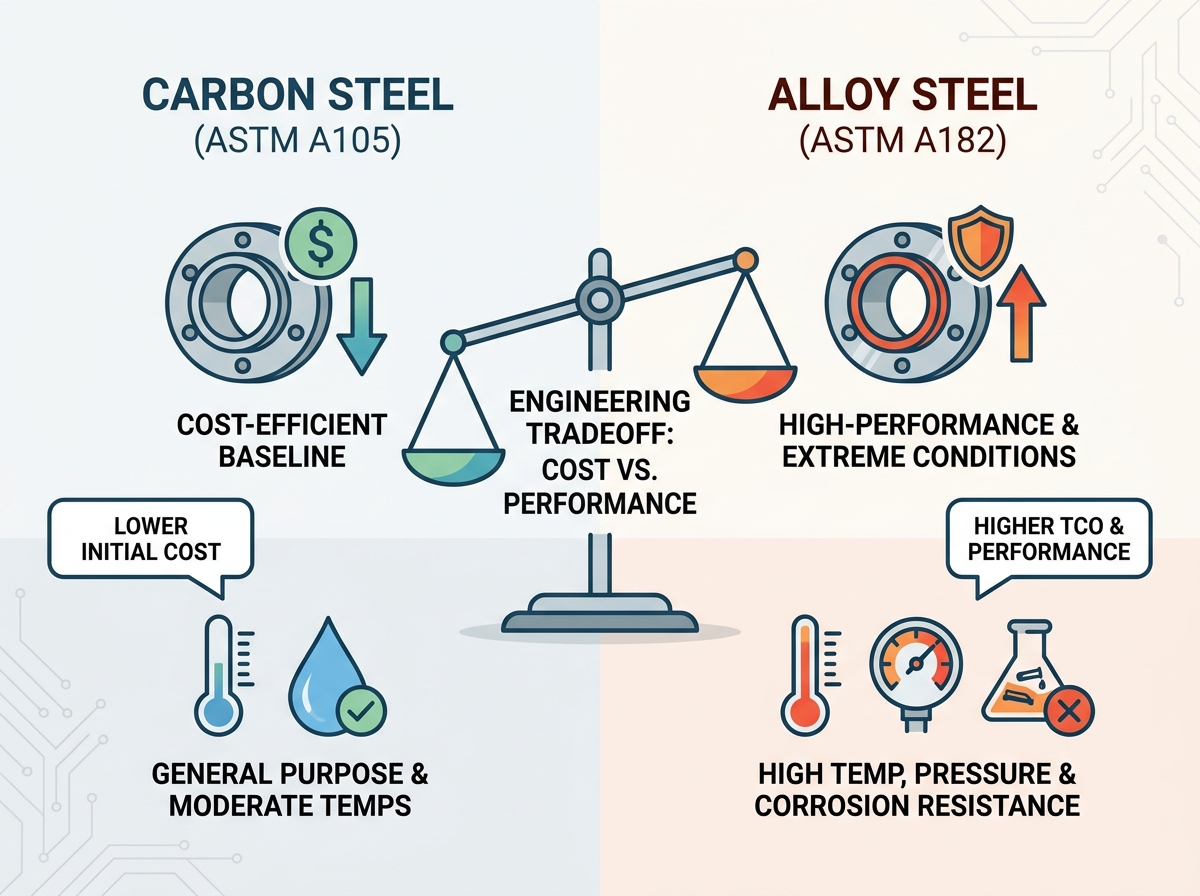
The core engineering challenge often boils down to a distinct tradeoff. You must balance the baseline cost-efficiency of carbon steel against enhanced operational resistance. Carbon steel offers excellent affordability and strength for standard environments. However, it falls short when pushed to the extreme limits of temperature, pressure, or corrosive fluids. In these severe environments, alloy alternatives truly shine.
This guide provides a strictly technical, specification-driven framework to navigate this decision. We will explore how to choose the correct pipe flange based on operational demands and compliance standards. Read on to master the structural nuances and industry requirements governing these crucial piping components.
Performance Baseline: Carbon steel is the industry standard for general-purpose applications, while alloy steel is engineered for extreme environments (high temperatures, high pressure, or severe corrosion).
Cost Variance: Alloy steel flanges carry a higher initial procurement cost and require more complex welding procedures, necessitating a Total Cost of Ownership (TCO) evaluation.
Standardization: Final material selection must align with precise ASTM and ASME standards (e.g., ASTM A105 for carbon, ASTM A182 for alloy) tailored to the specific fluid and environmental conditions.
Carbon steel serves as the undisputed workhorse of the piping industry. We define its composition primarily through its iron and carbon content. Manufacturers add very minimal alloying elements during the smelting process. This simplified metallurgical profile delivers highly predictable behavior under standard mechanical stress.
You gain significant strengths when choosing this material. Carbon steel boasts immense structural integrity and exceptional impact resistance. It offers excellent weldability across diverse environmental conditions. Procurement teams also favor it. It remains universally available and heavily stocked in global supply chains.
Despite these advantages, you must recognize critical limitations. Unprotected carbon steel remains highly vulnerable to active corrosion. Rust develops rapidly upon exposure to moisture or reactive chemicals. Furthermore, it loses crucial tensile strength at elevated temperatures. Engineers typically restrict standard carbon grades to environments below 800°F (426°C). Pushing beyond this threshold invites dangerous structural fatigue.
Alloy steel elevates baseline performance through complex metallurgical engineering. We define its composition as a carbon steel base enhanced with specific elemental additions. Foundries carefully blend varying percentages of chromium, molybdenum, nickel, or vanadium into the molten steel. Each element targets a precise structural weakness found in standard carbon grades.
These elemental additions create formidable strengths. Alloy materials retain immense structural integrity at extreme temperatures. They strongly resist thermal creep. Creep refers to the slow, dangerous deformation of metal under constant stress and high heat. These materials also offer superior resistance to aggressive oxidation and chemical degradation.
You will encounter these specialized components in demanding industrial sectors. Power generation facilities rely on them for superheated steam transport. Chemical processing plants use them to manage highly reactive fluid transfers. High-pressure oil and gas extraction sites depend on alloy resilience to prevent catastrophic blowouts.
Thermal dynamics dictate a significant portion of piping design. Carbon steel performs flawlessly in ambient-to-moderate heat scenarios. It handles standard municipal water routing and low-pressure steam without issue. However, continuous high-heat exposure rapidly degrades its grain structure. The metal softens and becomes susceptible to unpredictable deformation.
Alloy steel masters thermal cycling. Facilities dealing with rapid temperature fluctuations demand this resilience. The addition of molybdenum locks the grain boundaries in place. This prevents the metal from stretching or warping over years of continuous high-heat exposure. You essentially buy structural insurance against thermal fatigue.
Harsh environments quickly destroy unprotected infrastructure. We must carefully analyze metal behavior in sour gas lines or acidic fluid routing. Sour gas contains deadly hydrogen sulfide. It aggressively attacks standard carbon networks, causing rapid hydrogen embrittlement and catastrophic cracking. Standard carbon requires heavy protective coatings to survive even mild atmospheric moisture.
Alloy compositions directly counter these chemical threats. Chromium acts as a primary defensive shield. It forms a microscopic oxide layer over the metal surface. This delays rust and stops localized pitting. Molybdenum further fortifies this defense against chloride-rich environments. These combined elements allow the material to endure highly corrosive streams unprotected.
System stress directly impacts load-bearing capacities. Tensile strength measures the maximum stress a material withstands before breaking. Yield strength indicates the point where permanent plastic deformation begins. Both metrics matter immensely in high-pressure networks.
Standard carbon provides adequate load-bearing capacity for Class 150 and Class 300 applications. However, massive pressure spikes can exploit microscopic weaknesses in standard carbon structures. Alloy variants offer much denser, refined microstructures. They easily handle extreme mechanical loads found in Class 1500 or Class 2500 systems. Their enhanced yield strength prevents the connection from stretching under immense hydraulic force.
Material procurement strategies require careful balancing. You face a direct material cost multiplier when upgrading to alloy materials. Foundries spend significantly more energy and raw resources to produce complex metallurgical blends. This directly inflates the initial procurement cost.
Supply chain realities further complicate project timelines. Carbon components represent heavily stocked commodities. Suppliers fill large carbon orders almost instantly. Conversely, highly specific alloy grades often demand specialized forging runs. You must account for extended lead times when specifying complex metallurgical profiles. Planning ahead prevents costly construction delays.
Industry standardization ensures global compatibility and safety. We primarily rely on two major ASTM specifications for standard applications. ASTM A105 represents the universal standard for high-temperature and ambient carbon connections. You will see this grade specified across almost every standard industrial blueprint.
Low-temperature environments demand different metallurgical properties. Cold climates make standard A105 brittle. Engineers specify ASTM A350 LF2 for these sub-zero applications. It undergoes specialized impact testing to ensure toughness in freezing conditions. We pair these materials with typical ASME B16.5 pressure classes ranging from Class 150 up to Class 2500.
High-performance networks rely exclusively on the ASTM A182 specification suite. This standard encompasses multiple specialized "F" grades. Each specific grade corresponds to exact operational limits and chemical combinations.
Common grades include F5, F9, F11, F22, and F91. Engineers match the specific F-grade to the exact threat profile. For example, F11 and F22 grades dominate high-temperature steam lines in power plants. They contain precise amounts of chromium and molybdenum tailored for steam service. The F91 grade pushes boundaries further, managing ultra-supercritical steam environments where lesser metals would instantly vaporize.
Never install piping components without proper verification. Counterfeit or mislabeled materials cause deadly accidents. You must emphasize the absolute necessity of requiring Mill Test Reports (MTRs). These critical documents arrive directly from the forging facility.
MTRs verify the exact chemical composition of the delivered batch. They confirm all mechanical properties, including tensile strength and impact toughness. Best practices dictate reviewing MTRs against project specifications before authorizing installation. Reject any component lacking clear traceability to a certified foundry.
Standard Material Grade Comparison Matrix
Material Category | ASTM Grade | Key Alloying Elements | Primary Application |
|---|---|---|---|
Carbon Steel | A105 | Manganese, Silicon | Ambient to moderate high-temp service |
Carbon Steel | A350 LF2 | Manganese (optimized for cold) | Low-temperature service, freezing climates |
Alloy Steel | A182 F11 | 1.25% Chromium, 0.5% Molybdenum | High-temperature steam, moderate corrosion |
Alloy Steel | A182 F22 | 2.25% Chromium, 1% Molybdenum | Extreme temperature steam, heavy industrial |
Alloy Steel | A182 F91 | 9% Chromium, 1% Molybdenum, Vanadium | Ultra-supercritical power generation |
Fabrication teams experience significant differences between these materials on the shop floor. Carbon components generally allow straightforward welding. Welders utilize standard procedures, typical filler metals, and ambient temperatures. The low carbon equivalent ensures a stable, defect-free weld puddle.
Alloy materials introduce severe fabrication complexities. The added chromium and molybdenum increase the risk of hydrogen-induced cracking during the welding process. Fabrication teams must apply strict pre-heating protocols. Pre-heating drives out moisture and slows the cooling rate. After welding, you must mandate Post-Weld Heat Treatment (PWHT). PWHT involves baking the completed joint in a specialized oven. This critical step relieves residual stresses and restores the joint's metallurgical properties.
Facility upgrades often involve mixed-material systems. You must carefully address the severe risk of joining dissimilar metals. Bolting a highly alloyed component directly to a standard carbon pipe creates a dangerous electrical circuit. The carbon material becomes an anode and sacrifices itself to the more noble alloy cathode.
This galvanic action accelerates rust exponentially. The carbon connection point will deteriorate and fail rapidly. You must mitigate this risk using proper electrical isolation. Installation teams use dielectric isolation kits. These kits feature mylar sleeves for the bolts and specialized phenolic gaskets. They break the electrical conductivity between the dissimilar metals, neutralizing the galvanic threat.
A piping connection functions as a unified assembly. Upgrading the primary metal piece accomplishes nothing if the supporting hardware fails. You must match the performance of all peripheral components to the same temperature and pressure ratings.
Standard carbon systems typically use standard ASTM A193 B7 bolts. Upgrading to a high-temp alloy environment often requires B16 bolts, which resist stretching under extreme heat. Gasket selection requires equal scrutiny. Plain elastomeric gaskets melt in alloy steam service. You must specify spiral-wound metallic gaskets or specialized graphite rings. Ensure the weakest link in your assembly exceeds your maximum operational parameters.
Making the correct specification choice requires disciplined operational analysis. Use the following framework to align material capabilities with your precise system requirements.
The piping system operates strictly in non-corrosive, neutral environments.
Continuous operating temperatures remain comfortably below the 800°F (426°C) degradation threshold.
Budget constraints strictly demand standardized, universally accessible components.
You need to avoid complex, time-consuming fabrication procedures like PWHT.
The specific application falls entirely within standard HVAC, municipal water transport, or basic low-pressure petrochemical lines.
The piping network handles highly volatile chemicals, severe sour gas, or aggressive acidic streams.
The system transports high-pressure superheated steam continuously.
Operating temperatures regularly exceed the safe mechanical threshold for standard carbon.
The facility experiences rapid, severe thermal cycling.
Higher upfront procurement costs are entirely justified by the prevention of catastrophic mechanical failure, severe maintenance downtime, or critical compliance violations.
The choice between these critical piping materials goes far beyond basic procurement costs. It relies entirely on strict operational parameters. Standard carbon remains an unbeatable choice for ambient, non-corrosive systems due to its strength and accessibility. However, high-stress environments demand the precise metallurgical defenses offered by alloy alternatives.
Your next steps require rigorous technical verification. Always cross-reference your exact system specifications against current ASME B16.5 guidelines. Ensure your chosen material handles both normal operations and emergency pressure spikes. Finally, consult directly with vetted manufacturers. Only source a flange from suppliers who provide comprehensive Mill Test Reports. Prioritizing material science over initial savings guarantees long-term facility safety and unbroken operational uptime.
A: Yes, you can bolt them together, but it requires careful engineering. Joining dissimilar metals creates a high risk of galvanic corrosion, which rapidly destroys the carbon component. You must manage this by installing proper electrical isolation kits, including dielectric gaskets and bolt sleeves. Additionally, you must ensure the weakest material rating easily meets the system's absolute maximum operating limits.
A: Alloy options carry a significantly higher initial cost. They generally cost 2x to 5x more than their standard carbon equivalents. The exact price difference depends heavily on the specific grade ordered (such as F22 versus A105). Market fluctuations in raw elemental materials, like molybdenum and chromium, also drastically impact the final procurement price.
A: Yes. While inherently more resistant to standard wear and active corrosion, alloy materials demand highly specialized handling during facility shutdowns. You must ensure maintenance teams strictly adhere to specialized welding and repair procedures. Omitting crucial steps like Post-Weld Heat Treatment (PWHT) during a quick repair will fundamentally compromise the material's structural integrity.