

: +8618979570760 :xuran1603@gmail.com WhatsApp:+8619170756831
English

Views: 0 Author: Site Editor Publish Time: 2026-08-14 Origin: Site


Industrial procurement carries immense operational responsibility. A single mismatched component can easily trigger catastrophic system failures. You might face unexpected pipeline downtime, hazardous chemical leaks, or critical compliance failures during routine inspections. Procurement teams understand this harsh reality. At the decision stage, moving from a general piping design to a finalized Purchase Order (PO) or Request for Quote (RFQ) requires intense scrutiny. You must adhere strictly to established engineering specifications. Even minor technical deviations can jeopardize safety and mechanical integrity.
This guide introduces the five critical, evidence-based questions procurement teams and piping engineers must ask. You will learn how to validate complex technical specifications effectively. We will show you how to evaluate supplier reliability and mitigate hidden installation risks. By mastering these specific inquiries, you ensure seamless system integration and long-term structural stability.
Pressure-Temperature (P-T) ratings dictate flange class; operating conditions must be verified against ASME/API standard de-rating curves.
The choice between connection types (e.g., Weld Neck vs. Slip-On) directly impacts installation labor costs and structural integrity under vibration.
Material compatibility extends beyond the pipe—it must account for process media, external environment, and galvanic corrosion risks.
Dimensional accuracy (NPS, bore size, and face type) is non-negotiable for proper gasket seating and flow dynamics.
Trustworthy procurement requires verified Material Test Reports (MTRs) and strict quality control documentation from the supplier.
Procurement departments sometimes face pressure to reduce initial budget outlays. You might feel tempted to under-specify pressure classes. This practice creates severe safety hazards. Premature component failure often results from matching a lower pressure class to a high-demand application. You must strictly match system design conditions to standard class ratings. Industry standards range from Class 150 up to Class 2500. A higher class number indicates a thicker, more robust physical profile.
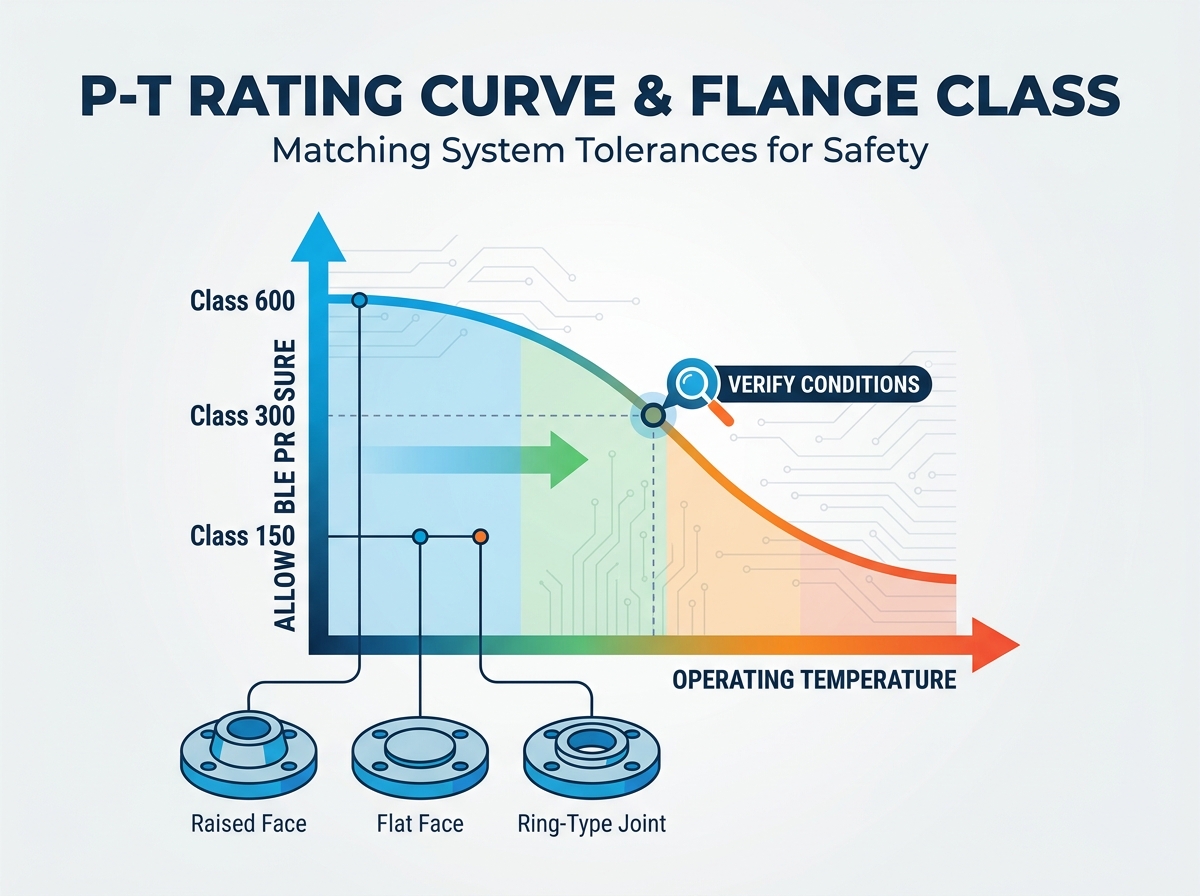
Engineers must confront the reality of standard de-rating curves. As system temperatures increase, the allowable pressure capacity of the component steadily decreases. You cannot assume a Class 150 part always handles 150 PSI. High heat softens the metal. This physical change compromises the structural seal. Operational teams must cross-reference actual operational peaks rather than baseline averages. You should consult standard ASME B16.5 or ASME B16.47 P-T charts before finalizing any specification.
Consider the performance behavior of a standard carbon steel flange under varying thermal conditions. The chart below illustrates how temperature spikes drastically reduce allowable working pressures.
Example: Carbon Steel Class 150 De-Rating Profiles
Operating Temperature (°F) | Maximum Allowable Pressure (PSIG) | System Impact |
|---|---|---|
-20 to 100 | 285 | Baseline safe operation for ambient fluids. |
300 | 230 | Moderate capacity drop. Requires gasket verification. |
500 | 170 | Significant de-rating. Nears threshold limits. |
700 | 110 | Critical capacity loss. Consider upgrading to Class 300. |
Always verify the upper thermal limits of your process media. Sudden steam flushes or chemical reactions often spike internal temperatures. You must design for the absolute maximum condition. This rigorous approach prevents catastrophic blowouts during unforeseen operational surges.
Choosing the correct mechanical connection directly influences your installation success. Different applications require specific attachment methods. You have several distinct solution categories to evaluate.
Weld Neck: These suit high-stress, critical applications perfectly. They feature a long, tapered hub. This hub smoothly transitions stress from the connection to the pipe wall. You must match the pipe schedule precisely. They carry a higher initial cost but deliver superior structural integrity.
Slip-On: These slide directly over the pipe end. They handle lower pressures effectively. Installers find them easier to align. However, they require two separate fillet welds for secure attachment. This increases welding labor time on site.
Threaded, Blind, and Socket Weld: These serve highly specific use cases. Blind types isolate piping sections safely. Threaded connections work well in low-pressure, small-diameter systems where welding poses a fire hazard.
Next, you must evaluate the component face type. Industry standards typically offer Raised Face (RF), Flat Face (FF), or Ring-Type Joint (RTJ) options. Raised Face profiles concentrate bolting pressure onto a smaller gasket area. This concentration increases containment capabilities. Flat Face profiles distribute bolting pressure across the entire surface. RTJ profiles utilize a metal ring groove for extreme high-pressure applications.
Mixing face types introduces massive implementation risks. You should never bolt a Flat Face cast iron component directly to a Raised Face carbon steel part. As installers apply torque to the bolts, the physical gap bends the cast iron. The brittle cast iron will inevitably crack. You must select your connection and face types based on expected vibration levels, routine maintenance accessibility, and existing mating equipment.
Material incompatibility creates severe operational problems. Accelerated physical degradation, aggressive pitting, and galvanic corrosion lead to premature system overhauls. Your material choice must survive both the internal fluid and the external atmosphere. Carbon steel grades like ASTM A105 serve standard industrial uses reliably. Stainless steel grades like ASTM A182 resist harsh chemical attacks. Specialty alloys handle extreme corrosive environments.
You must match the component material precisely to the surrounding piping. Connecting dissimilar metals triggers galvanic corrosion. The more active metal acts as an anode and corrodes rapidly. You also need to account for the chemical composition of your process media. Highly acidic fluids require robust corrosion allowances. Furthermore, evaluate the ambient environment closely. Offshore drilling platforms expose metal to constant saltwater spray. High salinity demands specific marine-grade alloys.
Over-specifying your material grades needlessly wastes procurement budget. Under-specifying them practically guarantees rapid mechanical failure. You should always verify the required corrosion allowance in your engineering designs. Ensure your chosen material standard meets strict regulatory compliance for your specific industry. For example, sour gas applications absolutely require adherence to the NACE MR0175 standard to prevent sulfide stress cracking.
Identify the exact chemical makeup of the internal fluid.
Assess external environmental threats like humidity or salt.
Calculate necessary corrosion allowances for a twenty-year lifespan.
Match mating materials to prevent galvanic reactions.
Job site delays drain project resources rapidly. Discovering components physically will not bolt together causes immense frustration. You must confirm every dimensional standard prior to finalizing your order. Key evaluation metrics include Nominal Pipe Size (NPS), Outside Diameter (OD), and the Bolt Hole Circle.
The bore match represents a critical implementation risk. When ordering Weld Neck variants, you must match the bore size exactly to the internal pipe schedule. The inside diameters must align perfectly. If the bore size proves too small, it restricts internal flow. If the bore size proves too large, it creates a physical step inside the line. Mismatches cause aggressive fluid turbulence. This turbulence creates localized erosion, eventually wearing away the metal wall entirely.
You must systematically audit your RFQ documentation. Never leave room for supplier assumptions. Ensure the RFQ explicitly states the governing standard. Common global standards include ASME, DIN, or JIS. An ASME component rarely aligns with a DIN counterpart. State the NPS clearly. Specify the exact wall thickness or schedule required. When procuring a complex pipe flange, explicit dimensional clarity prevents expensive rework and schedule overruns.
Always double-check bolting patterns. A slight millimeter deviation in the Bolt Hole Circle prevents stud insertion. Request standard dimensional drawings from your supplier if any ambiguity exists. Comparing actual component drawings against your site schematics guarantees a perfect mechanical fit.
Global supply chains harbor hidden dangers. Receiving counterfeit, substandard, or entirely non-compliant materials remains a persistent threat. Unverified materials routinely fail regulatory audits. They also fail rigorous site inspections. You must assess your supplier's quality management systems rigorously. Documentation rigor separates reliable partners from risky vendors.
Comprehensive Material Test Reports (MTRs) serve as your absolute trust indicator. An MTR provides crucial chemical and physical property data. It guarantees traceability straight back to the original raw material heat batch. Without a verified MTR, you cannot prove the physical strength of the steel. You cannot confirm its chemical composition. Installing unverified metal into a pressurized system constitutes gross negligence.
You should proactively incorporate a strict documentation checklist into your RFQ. Ask potential vendors to supply sample MTRs. Require definitive proof of their non-destructive testing (NDT) capabilities. Reliable manufacturers perform ultrasonic, magnetic particle, or liquid penetrant testing to identify hidden micro-fractures. Furthermore, demand current ISO or API certifications before shortlisting any vendor. If a supplier hesitates to provide compliance paperwork, you must immediately disqualify them from your procurement process.
A successful industrial procurement strategy relies entirely on strict parameter verification. You cannot base critical engineering decisions on unit price alone. Mismatched components invite disastrous leaks, severe safety hazards, and regulatory penalties. By asking these five targeted questions, you validate exact pressure limits, mechanical face compatibility, material endurance, dimensional accuracy, and supplier transparency.
We advise you to audit your current RFQ templates immediately. Integrate these five evaluation dimensions into your standard purchasing workflow. Remove vague language and demand exact engineering compliance from your vendors. Finally, encourage your team to utilize technical RFQ checklists. Consult with a specialized engineering sales team to validate highly complex specifications before you finalize your next major pipeline order.
A: No. Industry standards strongly advise against this practice. Bolting a Flat Face component (especially brittle cast iron) to a Raised Face steel component creates a physical gap. As you apply torque to tighten the bolts, the bending stress will likely crack the cast iron piece. Always match face types exactly.
A: These standards primarily differ based on physical size. ASME B16.5 covers sizes ranging from 1/2 inch up to 24 inches in nominal pipe size. ASME B16.47 covers larger diameter systems, specifically sizes from 26 inches up to 60 inches.
A: A designation like "Class 150" does not mean the part holds exactly 150 PSI. The actual safe working pressure depends entirely on the operating temperature and the specific material grade. Higher temperatures significantly lower the allowable working pressure. Always consult standard pressure-temperature de-rating charts.
A: They are often reusable, but you must inspect them rigorously. Check the seating face for deep scratches, dents, or pitting. Ensure no physical deformation occurred during previous torquing. You must always discard and replace the old gasket, as gaskets permanently deform during initial installation.